

 Add Comment
|
Add Comment
|
 Related Links
|
Related Links
|
 TrackBack
 Related Content
Making a Pinhole Lens for Canon EOS Camera
why are you doing this? To take close-up shots? It seems like making a pinhole for a camera with a lens is a weird step backwards...
Dont Understand
Fri Jan 25 21:54:13 PST 2002
There are quite a few reasons why it makes sense to put a pin-hole lens on a sophisticated SLR. Of course, I will cover these topics when I get a chance to finish the article. Stay tuned . . . 8-)
Chieh Cheng
Fri Jan 25 22:19:20 PST 2002
Pretty cool. Arent pinhole lens supposed to give great depth of field and therefore be very sharp? These example pics seem pretty fuzzy, did you use a tripod?
Jman
Wed Jan 30 17:26:23 PST 2002
Depth-of-field and sharpness are un-related. The confusion here arise out of the association between object in focus and sharpness of the lens. A lens that is not very sharp can still achieve large depth-of-field through a small aperature. This is the case with the pin-hole lens. Pin-hole lens are generally not very sharp, due to the lack of lens to correct diffraction and aberration. Thus, causes pictures to have fuzziness and surreal effect you can't get from regular lens; one reason to use pin-hole lens on a SLR. Search for "Lens FAQ" on the internet for more technical details.
Chieh Cheng
Thu Jan 31 14:32:59 PST 2002
I assume you use an aperture priority mode on the camera so that it controls the shutter speed but doesn't try to adjust the non-existent aperture controls on the body cap? So you don't have to worry about exposure calculations?
Jeremy Taylor
Wed Feb 13 12:05:13 PST 2002
With the non-existent aperture control, either P or Av mode works just fine. So far, I have always had success with the internal meter of the camera. Sometimes to deal with recipical failures where I have to do my own calculation, I use the M mode.
Chieh Cheng
Thu Feb 14 10:49:04 PST 2002
Regarding sharpness: I've seen articles on pinhole cameras, where it was recommended to put the pin hole through a piece of foil. I believe the thin sharp edges of the hole increase image sharpness. The body cap could be modified with a larger opening, with foil attached.
Ed
Tue Jun 11 23:11:00 PDT 2002
I tried it with my Yashica and have gotten some pretty good results. According to Ansel Adams' boot "The Camera", the hole should be in gold foil and 1/64 of an inch in diameter. I tried Your method of making a pinhole out of an old body cap but modified your method slightly; I traced around the body cap with a pencil on a piece of paper, cut out the resulting circle, folded it in half, then half again. That gave me the exact center of the lens cap. I marked the center of the cap and then heated a needle over a flame while holding it with locking type (Vise Grip) needle nose pliers. I pushed the red hot needle through the center of the lens cap. Worked like a charm, though I had to heat the needle several times. My daughter used the idea to win sweepstakes in her science fair project, pointing out that pinhole cameras are a lot of fun and a good way for kids to learn about lots of different things, but are difficult to make, load, develop, etc., for 9 year olds. The pinhole 35mm can teach them the same principles and be a lot more user friendly. Thanks again, Hal C.
Hal C.
Tue Mar 4 08:47:11 PST 2003
I was going to try to make this pinhole lens with a Canon EOS D60. Do you think it will work?
Hal W.
Tue, 20 Apr 2004 10:35:12 -0400
Yes. It will work. It should work with any SLR camera.
Chieh Cheng
Tue Apr 20 10:20:37 PDT 2004
geez, I still have anothe six hrs of work to do before I can go home and try this.
:-(
Tom
Tue Dec 7 00:20:33 PST 2004
Has anyone tried this with non-dsl digital cameras? I have a Minolta A2, I would buy another cap just to try it out.
Trey Wiggins
Fri Dec 10 21:24:34 PST 2004
I just stumbled into this site, and find the cap idea fascinating. Certainly going to give this a try. I've wanted to experiment with pinhole cameras, but was put off due to lack of darkroom.
Sounds like a great deal of fun :) Thanks for the website and the information.
Tony C
Mon Dec 27 20:24:59 PST 2004
When I first tried this idea on my own, I forced a pin through the center of the body cap... After having done so, I learned that the aperture of the hole is a huge factor in its performance. Since I did not want to be stuck with just one f/stop (you can determain the f/stop of the pinhole by using some amasingly simple, yet confusing, equations that I wont even go into... Trust me).
I decided to drill a monster hole, maybe about 5mm, but I did not leave it so large. I could then couver it with very thin aluminum foil. Since aluminum is much softer, you have more controll over the sive of the pin hole. This is done by the size of the needle,as well as how much pressure you apply.
For maximum DOP and sharpness, you want a small aperature hole. You may think that an ordinary pin head is small enough, but going just a bit smaller has drastic effects on your images.
Jordan S
Fri Feb 4 19:45:43 PST 2005
If you're not technically adept enough to make your own pinhole, you can buy a pinhole body cap here:
http://www.adorama.com/FYCEOS.html (This is for Canon, but they have lenses for several other camera manufacturers, too.)
Mine came the other day and I just got back from an afternoon of shooting. It seems to work well, although it's harder than heck to compose the image, as the viewfinder is nearly dark. I ended up making a rough guess, then adjusting based on what I see in the camera's LCD after I take the photo.
I set the camera on "Program," and let its light meter calculate the exposure. It does a fairly good job most of the time, but sometimes I have to set the exposure time manually if it isn't hitting it.
The digital camera makes it so easy--I couldn't imagine doing this with film!
David B
Sun Apr 3 16:47:03 PDT 2005
You are welcome to visit my "Digital Pinhole Gallery" - Canon EOS 10D with a camera body cap pinhole.
http://www.MarekUliasz/pinhole
Marek
Sat Apr 9 14:32:12 PDT 2005
make that marekuliasz.com/pinhole
I guessed .com - then it worked
Murray
Murray
Sun, 5 Jun 2005 22:00:26 -0700
Looking through the viewfinder of the SLR camera without the lens, the image is blur. So how you frame your subject?
Alice
Mon, 4 Jul 2005 04:55:05 -0700
At 7:31 PM, John Milton said...
There is a company, Lenox Laser, that sells factory made pinhole body caps.
Their website is here:
http://www.lenoxlaser.com/
Billy
Mon, 4 Jul 2005 15:20:40 -0700
Alice, if you have a pinhole lens on the front of your SLR camera, the pinhole will focus an image on your film plane/viewfinder. You will see an image.
Chieh Cheng
Tue, 5 Jul 2005 17:29:58 -0700
Without having read your artikel, I made at pinhol for my 350D. Used the same cap, but drild a hole about 1/2 cm. Then I used a pice at alu from a beercan (had the beer myself) and taped a 1x1 cm pice of alu with a 0.2 mm hole in center of the 1/2 cm hole.
I am using TV to take the pictures
Attached Image:
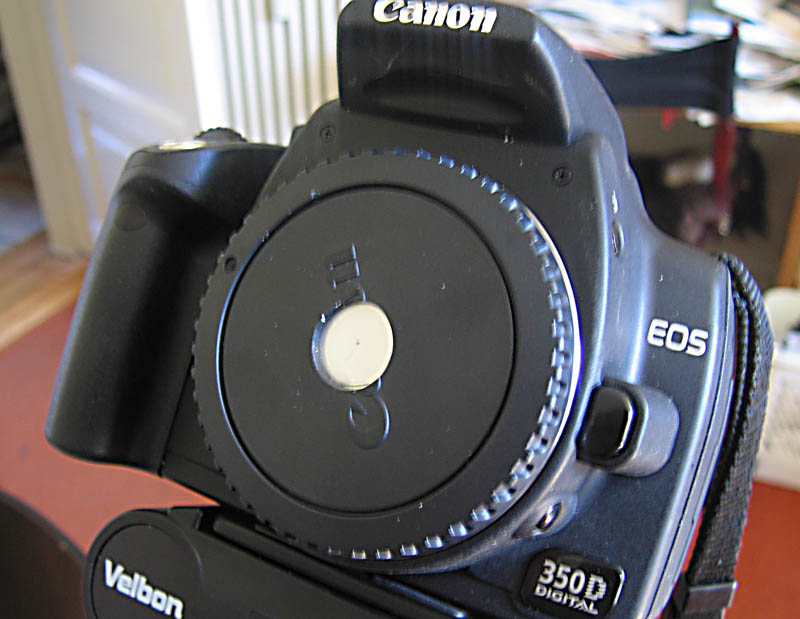
canon 350D Pinhole.jpg
niels-erik hartmann
Wed, 3 Aug 2005 12:25:51 -0700
Ive used a Practica body bellows and an extentsion tube with the pin hole in metal shim. This gives a very good zoom pinhole camera. In good light very fine landscapes can be achieved. Portraits are only as good as the person staying still.
N Vaughan
Sun, 6 Nov 2005 17:29:02 -0800
I have made a similar pinhole "lens" for my M42 screw mount analog camera. Instead of making the hole directly into the body cap I drilled a 5mm hole into the cap and taped a foil with the hole in it behind it. It's fun to use and works fine even with 35mm film
Martin Siegel
Mon, 27 Mar 2006 05:51:22 -0800
Forgot one thing: Framing: It can be either done through the hole (if there is enough light) or a normal lens (e.g. 50 mm on a 35mm SLR) will do the trick as well. Possibly the angle of view for the pinhole is a little bit wider.
Regards
Martin
Martin Siegel
Mon, 27 Mar 2006 05:56:09 -0800
check this website : http://pinhole.cz
there is a small software to calculate usefull settings for you pinhole camera - like view angle or shutter speed...
and take a look at DIRKON paper pinhole camera - i've build one myself - fun !
ps: someone mentioned about pinhole tele-lens - more info please :]
peace
dxxp
dxxp
Mon, 8 May 2006 06:53:28 -0700
the pinhole body-cap is a great tool
to find dust on the camera sensor!
alas, since it is too far away from the sensor it does not allow wide angle shots.
wouldn't it be interesting to get a cheap fixfocus camera, remove the entire lens, put a pinhole as close as possible in front of the sensor and play with a wider angle?
here are some examples:
Digital Pinhole / Photography without lens
wide angle
Thu, 10 Aug 2006 07:14:34 -0700
we have been selling slr body caps with pinholes in them for over three years
doug has been handling the calls and orders peek @ www.lenoxlaser.com
joe
Thu, 16 Nov 2006 15:53:02 -0800
The mathematics of pinhole imaging is complex. The hole diameter is dependant on both the focal length and the wavelength of the light. With a standard distance of 50mm from the lens cap to the sensor plane the optimum hole size is about .0.312 mm. This gives an f number of approx 185. It is possible to reduce the exposure time by replacing the pinhole with a Photon, or Pinhole Sieve. The former consists of a pinhole surrounded by concentric rings of decreasing width; the latter is similar but rather than concentric rings, consists of groups of concentric pinholes.. I am currently developing lenses based on these which should be available in the near future at a cost of $8-10 each, or $15-20 for a set of 3 (Pinhole, Pinhole Sieve, and Photon Sieve). Initial production will be for Canon EOS and Nikon cameras, but subject to demand, I will produce other lines as and when necessary
Steve Wilkins
Sun, 17 Jun 2007 20:45:39 -0700
Is it possible we protect the sensor from "extra dust" by puttin an acrylic protection?
DuLt
Sat, 03 May 2008 12:00:00 +0000
As far as framing goes, depending on what you are shooting you could place a bright led or flashlight on or near your subject and compose off of that. Thats what I do when I am indoors and it works better than guessing. It does have to be pretty bright though.
Nathan
Mon, 02 Jun 2008 03:59:24 +0000
Rather than measure the inside of the cap with a ruler to find the dead centre I 'wetted' the stepped ring with a water based pen and quickly 'stamped' the image on a piece of paper. That left an inked circle which I cut out carefully. The disc of paper fitted exactly the inside of the cap. By folding the paper into half and then half again - ending up with a cone shape - I snipped off the point, leaving in the dead centre of the disc a small hole. This disc when put back into the cap can be used as a template to mark the dead centre of the cap.
Nigel Bewley
Mon, 03 Nov 2008 10:27:47 +0000
I used an analog SLR Canon 300V to make my pinhole camera and I set my shutter time manually at 2000. But, without using a 'real' lens, I am not able to adjust the aperture manually. Is this a problem for making pinhole photos? Is it necessary to adjust the aperture for the pinhole to work?
How did you guys handle this?
Siglinde Burghouts
Sun, 20 Sep 2009 14:17:12 +0000
The aperture is the size of the pinhole. You can't adjust the aperture, because you can't change the size of the pinhole on the fly. You determine the aperture by how big you decide to make the pinhole.
Chieh Cheng
Mon, 21 Sep 2009 01:55:03 +0000
Thanks for the article, i amtotally trying this out tomorrow!
catSouey
Fri, 04 Dec 2009 02:37:42 +0000
Just my experience, can put a filter over the body cap to limite dust coming into the sensor on long exposure. Sometimes can use ND or Cir-Polarizer
dolcetto
Fri, 12 Feb 2010 07:44:15 +0000
Just started trying this and found the angle of view too small for my liking. This morning I cut the concave bottom out of a Red Bull can and made a pinhole in it. Then, mounted the can bottom inside the cap so the "lens" was closer to the sensor. the angle seems to increase by around 10~20 degrees. the first pic was taken just holding the cap lightly in place to make sure the mirror did not snag!
Roy
Sat, 22 May 2010 09:28:47 +0000
That's a good idea, Roy. I thought of way to move the focal point, such as using extension tubes to increase the distance of the pinhole to the sensor. But I couldn't think of anything to move it closer. I'm glad you posted your idea.
Chieh Cheng
Sun, 23 May 2010 05:24:35 +0000
I'm curious about the effect of punching a hole through a lens cap and shooting through the lens and then the pinhole. I don't have a spare cap sitting around or I'd try it. But, what are your thoughts on this?
Anthony
Tue, 30 Nov 2010 19:42:50 +0000
Anthony, I'm not sure I understand exactly what you are asking. Please elaborate on your idea. Thanks.
Chieh Cheng
Wed, 01 Dec 2010 16:54:12 +0000
Hey i made a pinholelens for my Canon eos 1000d today, but i'm not sure it works.. All i see on the screen after i took the picture is a lot of black and only a little tiny point of light. What went wrong? I did exposure bulb, about ten sec, and iso 200 and later I tried 400. The diaphragm was saying 'F00', and i couldnt change that. I used the M-mode. Maybe my camera dont recognise the lens? Has anyone manage the pinhole with a eos 1000d? I really hope someone knows what i'm doing wrong! Thanks
Terry
Tue, 26 Apr 2011 22:00:01 +0000
Using the manual mode is correct. The camera shows F00, because there is no aperture. You used the camera's body cap, right? Try shooting in a bright location. Like under bright sunlight. Got a picture of what you made?
Chieh Cheng
Sun, 01 May 2011 17:45:56 +0000
Hi! I just built my pinhole using the body cap of my Canon 550D. I used the foil of a tealight to make the hole even smaller than the one I drilled in the cap. The problem is: everything is too out of focus.. Even through the viewfinder... The hole was made by the smaller pin I found. What could be the problem?
Helenp
Sun, 13 Nov 2011 11:31:26 +0000
The smaller the hole, the less light and longer shutter times. But the smaller the hole (f-stop), the sharper the image. So you got a too big hole for yourself now. :)
Jamie
Mon, 12 Dec 2011 15:37:14 +0000
Add Comment
|
Related Links
|
TrackBack
Related Content
Did your message disappear? Read the Forums FAQ.
Add Comment
Spam Control | * indicates required field
TrackBack
TrackBack only accepted from WebSite-X Suite web sites. Do not submit TrackBacks from other sites.
Send Ping |
No TrackBacks yet. TrackBack can be used to link this thread to your weblog, or link your weblog to this thread. In addition, TrackBack can be used as a form of remote commenting. Rather than posting the comment directly on this thread, you can posts it on your own weblog. Then have your weblog sends a TrackBack ping to the TrackBack URL, so that your post would show up here.
Messages, files, and images copyright by respective owners.
373 Users Online
|
Get Our
$10000-above 
$5000-$9999
$2000-$4999
$1000-$1999
$500-$999
$200-$499
$100-$199
$50-$99
$25-$49
$0-$24
Gift Certificate

|
|